How To Learn Everything About Design Without Going To College

In less time than it takes to finish a semester in college, a new school says it can teach all you need to know about digital design.

Students at The Designation pay $3,000 to attend three-hour classes twice a week for nine weeks to learn the philosophy and fundamentals of Web and graphic design, including HTML and CSS, wireframing and design theory. Kevin Yun teaches development, veteran GrubHub designer Zeke Franco covers user experience design, and Reppio creative director JJ Lee handles branding and Adobe training.

The Designation’s first — and so far only — session, now underway, was a profitable one, says founder Yun. Thirteen students’ tuition covers rent at Loop digital agency Manifest Digital, where classes are held, as well as instructor compensation, setup and marketing costs.

Yun is a self-taught designer and senior at the University of Illinois at Urbana-Champaign, where he’s somewhat reluctantly studying finance. For Yun, running The Designation is more than a summer job. He describes his commitment as “full time at night” as he juggles designing for two other startups, including Fitsby, an exercise app.

Yun sees The Designation’s curriculum as superior training for career-changers or recent graduates. “There’s nobody else really teaching digital design classes in Chicago at the moment,” he says.

Click here to read the rest of the story at Grid!
How Two Top Marketers Leverage Twitter #Music

On April 18, Twitter launched a new app called #Music, a standalone discovery engine that analyzes all the music data shared across the network every day. Feeding off users’ tweets and engagement, #Music offers charts based on buzz, along with profiles of up-and-coming artists and musicians whom users follow on Twitter.

Celebrities and musicians such as Ryan Seacrest, Ne-Yo and Blake Shelton were among those who got pre-launch access to the app, and they were effusive with their support on Twitter. The anticipation their support built contributed to the app’s debut at number five on the App Store chart; it even hit the top spot on the music apps list.

Since then, however, growth has slowed. Possible reasons for the decline in downloads could be that the app is only available on the web or iOS — but this is sure to change soon. Rdio or Spotify accounts are also needed to listen to full tracks, which could limit casual users experimenting with the #Music app. However, as you’ll see, continued support from the music industry and expansion to other mobile platforms makes #Music worth your time — and opens the door to smart marketers.

We chatted with Alyssa McClusky of DreamLocal, an internet marketing agency, and Joseph Havey, an account manager at Shelten Media, LLC, to get their thoughts on the marketing opportunities that Twitter #Music presents.

Read on to find out what some of those opportunities are by clicking here.

GM’s Michael Savoni on Why You Need a Customer Service Twitter Handle

Communities have changed a lot in the past few years, having manifested online in ways no one could have previously imagined. Still, some things have stayed the same. Social networks allow people to broadcast their views much the way they do in person, but often with much greater reach. Much of the time those opinions are positive, is your brand ready to respond when they’re less than complimentary?

As more companies are realizing, online conversations are varied and complex. While this fact is daunting, it also points to a great opportunity: To join conversations and provide value to customers who are asking for it, and even those who aren’t.

One of the best ways to join these conversations is to create a Twitter handle dedicated to serving customer needs that is separate from your business’ main account. Not only does this approach prevent dilution of brand messaging on your main account, it also gives you a way to provide meaningful content and tips from a valid source. It’s the same reason most companies have dedicated customer service numbers.

Read on for best practice from General Motors’ social media lead Michael Savoni by clicking here.

A Pricey, Exclusive Gym That’s Keeping Out Those Who Can’t Weigh In

Walk past most gyms in Chicago, and you’re liable to get into a staring match. Wide windows frame hard bodies galloping on treadmills in a constant advertisement to passersby.

Walk past Downsize Fitness in the West Loop, however, and you won’t see much. The windows are frosted, and low-resistance treadmills face a wall with few mirrors. Downsize is not a place to see and be seen. Indeed, that sense of privacy is one of the gym’s selling points. Others include extra-large towels, private showers and seated elliptical machines.

Everything about Downsize caters to people who are overweight. That’s because the gym doesn’t accept members who aren’t trying to lose at least 50 pounds. Francis Wisniewski, who owns Hard 8 Trading and Forty 4 Asset Management, financed the gym himself in 2011. Wisniewski has since added a second location, in Dallas. Now, he’s interested in taking Downsize national.

Read more about this unusual fitness center by clicking here or picking up a copy of today’s Chicago Sun-Times!

On Effort, Unity and Strength: AdYapper to Join TechStars NYC

“You don’t just submit an application and hope for the best. It needs to be an all out, multi-pronged and sustained assault,” says Eliot Hirsch, AdYapper’s CEO and one of its three co-founders. He and his team found out this week that they’d been accepted to TechStars NYC’s 2013 class and Hirsch insists it wasn’t luck that got them there. Of the 1,700 applicants this year, only 11 made the cut, which works out to an acceptance rate of 0.6 percent.

Getting his ad transparency startup through the door was no easy task and, in fact, Hirsch and his team were so aware of the probability of not making it that they prepared for that scenario. Having bootstrapped for more than a year before and recently closing a bridge round funded by some Chicago angels, TechStars, mentors, friends and family, the AdYapper guys were ready to keep doing it themselves, if it came to that.

After several years in the advertising industry, Hirsch (a UX designer) recognized the inefficiencies in terms of transparency, data and time—as well as the money lost as a result. He teamed up with Wojo Wietecha, now CTO, who previously founded Poland’s largest social network, then one of its largest ad networks. They were joined by SVP of Media Products Kal Patel, a former startup founder and senior executive at large brands. Hirsch describes Patel as “a light of positivity that never, ever goes out.”

Read more about AdYapper’s approach to getting into one of the country’s most competitive incubators, TechStars, by clicking here.

Def Jam Co-Founder Russell Simmons Talks Partnerships And Leveraging His Successes

Long before “disruption” became a Silicon Valley buzzword, Russell Simmons, 55, was upending paradigms left and right. His Def Jam record label introduced hip-hop to a broader audience, while his Phat Farm clothing line blurred the line between urban and prep. They also made Simmons a wealthy man. Forbes reckons he’s worth about $325 million.

Simmons discussed the evolution of his career and his intentions to upend digital with two new companies, Narrative and All Def Digital, at the Digitas xCulture anniversary celebration on March 27. After the event, Simmons took questions from Grid.

In this case, “Grid” is yours truly! Click here to read what Russell and I talked about.


Lessons from Russell Simmons at Digitas xCulture

Russell Simmons

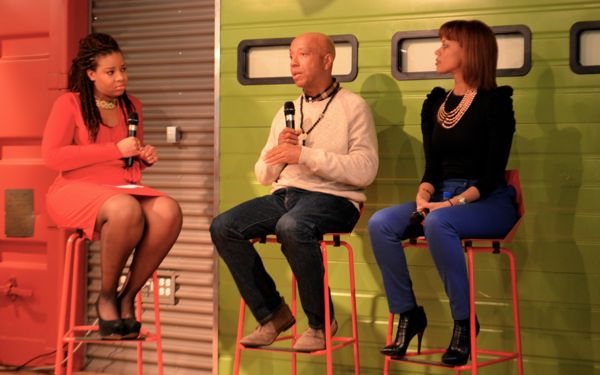
[Left to right] Digitas’ Ronnie Dickerson, Russell Simmons and GlobalGrind’s Tricia Clarke-Stone at Digitas March 27, 2013

A year ago, Digitas Chicago decided to take its cross-cultural marketing efforts to the next level. They had a vision for equipping employees to deal with a changing multicultural marketplace. It was they who introduced the Digitas xCulture platform last spring, leading to similar programs that launched in New York City and Boston in the fall.

Digitas xCulture frequently hosts speakers ranging from researchers and industry professionals to public figures such as Olympic athletes and singers. To celebrate its first anniversary, hip hop mogul and uber-successful entrepreneur Russell Simmons took the stage with Tricia Clarke-Stone, co-President at GlobalGrind.com, to speak with employees about his experience working with diverse audiences on March 27.

Simmons is a bona fide jack of all trades, able to spot trends long before they go mainstream (in fact, it’s just that talent that helped him succeed in music, fashion and content). He is also known for his emphasis on spirituality and faith in life and business, a perspective that certainly sets him apart from the many numbers-driven magnates we’re used to.

It was precisely this point of view that I found at once intriguing and inspiring as I heard him speak to the hundred or so employees crammed into Digitas’ event space last Wednesday afternoon. Here are some of his best lessons and the whole story.

Can Stock Mfg. Co. Do For Clothes What Farmers Markets Did For Produce?

For decades, the only garments to come out of the 19,000-square-foot military-clothing factory at the corner of Lake and Pulaski in Garfield Park were sewn in muted shades of olive drab, gunmetal gray and navy blue. But in July, there came a whole different look: piles of brightly colored shirts, pocket squares and ties meant for Bucktown hipsters, not Pentagon bureaucrats.

Behind the colorful clothes are entrepreneur Jim Snediker, factory owner Areill Ives and three other co-founders of Stock Manufacturing. The quintet is betting their locally made duds will strike a vein of civic pride. Every piece of Stock clothing comes tagged “Proudly made in Chicago” — and backed by Snediker’s personal quality promise. “I guarantee,” he says. “You’re getting a damn good piece of clothing, and you’re getting it at an affordable price.”

Read more about this plucky new company by clicking here, and pick up a copy of Chicago Grid in this Sunday’s Sun-Times!

Five Illinois Companies Make Top Work-Life Balance List

Work to live, or live to work? The former is a broadly-acknowledged philosophy at 25 American companies that rank highest for their emphasis on work-life balance. Glassdoor.com, an online career community, culled employee feedback from the past year to identify those companies that prioritized their workers’ needs nearly as much as the organization’s.

Five Illinois-based companies made the second-annual list, with CareerBuilder breaking into the top five. Orbitz (12), Discover (16), Morningstar (17), and Navteq (23) are also ranked. In fact, Illinois features more companies on the list than any other state. California and Texas clock in with four companies each, and Massachusetts follows up with three.

For the employees at these companies, perks range from telecommuting options to flexible hours. To find out more about their commitment to work-life balance, we asked employees at the five Illinois companies the same three questions.

Click here for their answers.

DealsGoRound Grows Up, Rebrands as MyCabbage and Raises $950K

Too many deals and no way to keep up? Have no fear, MyCabbage is here. What started as a service project in CEO Kris Petersen’s kitchen two years ago has grown into a full blown deals marketplace, complete with social capabilities. What’s more, the company formerly known as DealsGoRound relaunched today after raising $950,000 from the likes of Lightbank, I2A and New World Ventures, plus some angel investors.

“We knew for quite some time that our product was evolving into something which was applicable across the world of savings and not specific to daily deals,” says Petersen. DealsGoRound was an appropriate name when their business operated on the reselling of deals from sites such as Groupon and LivingSocial, but now that they’ve expanded into the coupon and gift card management space, the name became more of a distraction. So how did the name come about? “Deals, gift cards, coupons…they’re all worth money, or ‘cabbage’ as we call it.”

Read more: Find out how MyCabbage intends to use their new funds and how Petersen feels about the growth of his business.